
PILLAR ONE · TRAINING CURRICULUM

New bars live or die on staffing quality. You can have a great concept, a well-funded business plan, a strong location, and a complete build-out, and still fail in the first six months because staff cannot execute consistently. Conversely, imperfect concepts with exceptional staff routinely outperform strong concepts with weak execution. Staffing is not a support function in bar ownership. It is the operational engine.
This page covers bartender training specifically for new bar openings – the hiring timeline, the onboarding structure, the training curriculum, and the documentation that protects the venue once operations begin. It is the opening-phase application of the broader bartender training framework authored by Ryan Dahlstrom. For the complete training system – the 140-page Ultimate Responsible Alcohol Service Manual – see bartendertrainingmanual.com.
New bars face training challenges that established operations do not:
Existing bars can absorb an undertrained new hire – the rest of the team covers the gap. New bars cannot. Every position must be competent at opening. Which means training cannot be informal and cannot be compressed.
Working backward from opening day:
Hire the general manager. The GM will participate in hiring the rest of the team, so they need to be in seat early. Look for:
Hire key roles:
This is also when you finalize the training manual and documentation systems. You cannot train staff without training materials. The materials must be in place before bartender recruiting begins.
For the complete training manual authored by Ryan Dahlstrom – 140 pages covering bartender responsibilities, training protocols, operations, responsible service, and incident management – see The Ultimate Responsible Alcohol Service Manual. This is the training document you need in place at this phase.
Hire the line team:
Quality is more important than speed. A bar that opens with six great bartenders outperforms a bar that opens with ten mediocre ones.
Structured training begins. Training runs three weeks, organized in four phases:
Phase 1 of training is onboarding – day one through day three. This is where the documentation layer gets built that protects the venue later.
Each acknowledgement is a separate signed document tied to specific content, not a blanket ‘I received the handbook’ statement. This matters for regulatory, insurance, and liability purposes. For the complete onboarding framework and all required forms, see Bartender Onboarding Checklist.
Phase 2 covers the core skills every bartender needs before working independently:
The responsible service content is particularly important for new bars because opening-week incidents get disproportionate attention. A well-trained staff protects the venue’s reputation and liability posture from day one.
At the end of three weeks of training, each bartender should be formally certified to serve alcohol independently. Certification involves:
Undocumented certification does not exist from a regulatory or insurance perspective. The documentation is what protects the venue if something happens in the first ninety days. For the complete certification framework, see The Ultimate Responsible Alcohol Service Manual.
Most states require alcohol server certification. Common programs:
These certifications are for the individual bartender. They are not a substitute for the venue’s internal training program. Responsible new bars maintain both – individual state certifications plus the venue’s own documented training program.
New bar founders have two options for training infrastructure:
Develop training materials from scratch. Typically requires 100-200 hours of founder or GM time, plus legal review. Produces materials custom-fit to the venue. Appropriate for venues with unique concepts, multiple locations, or chains that need proprietary training systems.
Purchase an existing operator-grade training manual and customize it for your venue. Typically requires 10-20 hours of customization time. Produces immediate training infrastructure. Appropriate for most new bar openings where the core content (responsible service, bartender standards, operational protocols) is substantially the same across venues.
Most new bar founders choose Option B because they do not have 100+ hours of pre-opening time to build training materials from scratch. The Ultimate Responsible Alcohol Service Manual is the operator-grade training document most new bar founders use. 140 pages, professionally formatted, customizable with [COMPANY NAME] placeholders, built to legal-defensible documentation standards. Authored by Ryan Dahlstrom – the same author of everything on opena.bar.
For new bar founders who want the complete opening system – business plan, startup cost spreadsheet, critical path checklist, and training manual – the Open a Bar Founder Bundle combines all four resources at a price below the sum of individual purchases. The training manual component is the same Ultimate Responsible Alcohol Service Manual that bartendertrainingmanual.com sells standalone.
How to Open a Bar pillar →the overall opening framework
Critical Path Checklist pillar →execution tracking including hiring timeline
Bartender Onboarding Checklist →detailed onboarding process
How to Train Bartenders for a New Bar →training execution specifics
The Ultimate Responsible Alcohol Service Manual →the complete training document
Open a Bar Founder Bundle →manual included with other resources
Ryan Dahlstrom
Author & Expert Witness
20+ years of hospitality operations. Author of The Ultimate Responsible Alcohol Service Manual and The Bar Starts Here.
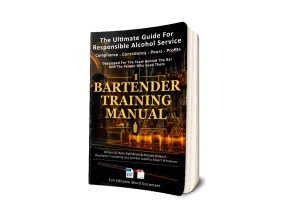
The Ultimate Responsible Alcohol Service Manual – 140 pages of complete bartender training and responsible service documentation. Also authored by Ryan Dahlstrom.
A one-page editable outline of the four-phase framework. Adapt it for your venue.
The Bar Business Plan is the planning side of 20+ years of bar operating experience — structured to the questions lenders, investors, and landlords actually ask.