
PILLAR ONE · TRAINING CURRICULUM

This page covers what actually goes into a defensible bar business plan: the sections, the content within each section, the financial projections that matter, and the structure that satisfies every audience. It is the educational foundation for the Bar Business Plan product, which is the complete, customizable, investor-ready document you can purchase and adapt for your specific venue.
Understanding the readers shapes what the plan needs to contain.
Commercial lenders – banks, SBA lenders, specialty hospitality lenders – read bar business plans to evaluate credit risk. They focus on:
Lenders are not investors. They do not care about upside. They care about probability of repayment. A plan structured for investors with growth projections but weak debt coverage analysis will fail bank underwriting.
Investors – silent partners, equity investors, family-office investors – read bar business plans to evaluate return potential. They focus on:
Investors are typically more comfortable with growth bets than lenders. But they also want to see realistic risk assessment, not pure upside pitches.
Commercial landlords – especially in premium hospitality corridors – often request business plans before signing leases. They focus on:
State and local liquor licensing authorities sometimes request business plans as part of licensing applications. They focus on:
The above framework is what it takes to build a defensible manual. It is substantial work — typically 100–200 hours of operator time to produce the first version, plus legal review.
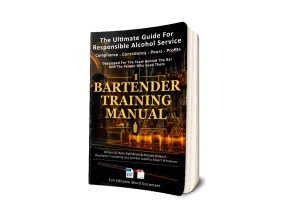
For operators who want the destination without the journey, The Ultimate Responsible Alcohol Service Manual is the complete, drafted, customizable manual. It is structured exactly as described above. It is designed to be adapted for specific venues by replacing [COMPANY NAME] placeholders and adding jurisdiction-appropriate regulatory content. It is the execution layer.
Operators building from scratch use this framework. Operators buying the destination use the manual. Both are defensible. The choice is time versus money.
A complete bar business plan has ten standard sections. Each serves specific readers. Weakness in any one section can disqualify the plan for some audience.
The one-page version of the entire plan. The concept, the market opportunity, the financial highlights, the funding request, the management team. Most lenders and investors read the executive summary first, then decide whether to read the rest. If the executive summary does not convince them, they do not read further.
A strong executive summary:
The legal and structural context. Legal entity type, ownership structure, mission and values, location, key success factors.
The context for the opportunity. Industry overview, trade area demographics, competitive landscape, target customer profile, market share assumptions.
Quality market analysis is specific and local, not generic and industry-wide. Lenders can tell the difference between a section that cites Bureau of Labor Statistics hospitality data for the nation and a section that analyzes the specific neighborhood where the bar will open.
The offering. Beverage program structure, food program if applicable, service standards, pricing strategy, cost of goods assumptions.
How customers find and return to the venue. Opening marketing plan, ongoing marketing plan, community integration, loyalty program, sales forecasting methodology.
How the bar actually runs. Location and facility, equipment requirements, staffing plan and hours, supplier relationships, licensing framework, technology stack, operational controls.
Who is running this. Ownership structure, management roles, key personnel resumes, advisory board, hiring plan from groundbreaking to opening.
This section disproportionately influences lender and investor confidence. Weak management teams kill plans that would otherwise approve.
The numbers. Pre-opening costs, startup capital requirements, monthly revenue projections for year one, annual projections for years one through three, break-even analysis, cash flow projections, return on investment calculations, sensitivity analysis.
This section has its own standards. The projections must be:
The specific ask. Amount, structure (debt, equity, or mix), use of funds by category, terms expected, repayment plan if debt, exit strategy if equity.
Supporting documentation. Sample menus, floor plans, equipment quotes, lease terms, resumes, market research data.
The financial projections section is the most scrutinized part of the plan. Specific components:
Revenue projections must tie to specific operational assumptions:
A revenue projection that says ‘year one revenue $1.2M’ with no operational basis is not credible. A revenue projection that says ’40 seats times 2.5 turnover times 5.5 operating evenings per week times $45 average ticket times 50 weeks times 85 percent ramp-up factor equals $1.18M’ is credible.
Beverage cost of goods for bars runs:
Plans with beverage COGS projected below 16 percent raise questions. Plans with beverage COGS above 28 percent suggest pricing or pour control issues.
Labor for bars typically runs:
Labor projections must include base wages, tip-share adjustments where applicable, overtime assumptions, benefits costs, payroll taxes.
Rent plus CAM plus utilities plus property tax pass-through typically runs 8-12 percent of revenue for healthy bars. Above 12 percent signals the venue may be over-rented. Above 15 percent is typically unsustainable.
Break-even analysis calculates the monthly revenue required to cover all fixed and variable costs. Bar break-even typically:
Plans that show break-even at month three of operation are unrealistic. Plans that show break-even at month eighteen suggest insufficient capitalization. Plans that show break-even at months six to nine are typical for well-capitalized, well-located venues.
140 pages · 23 chapters
Writing a bar business plan from scratch that satisfies all four audiences (lenders, investors, landlords, regulators) takes most founders 100-150 hours. The Bar Business Plan product is the complete document with all ten sections pre-drafted, financial model pre-built, and industry-standard assumptions already populated. You customize for your specific venue in 20-30 hours instead of building from scratch.
This is particularly valuable for founders who are strong on operations but less experienced with formal business plan writing – which describes most bar owners. View the Bar Business Plan product.
Bar Business Plan Template →what a template should contain
Bar and Grill Business Plan →food-service-specific variant
Business Plan for Bar Investors →investor-focused treatment
Bar Startup Costs pillar →the numbers that feed the financial projections
Bar Business Plan (product) →the complete plan document
Open a Bar Founder Bundle →plan plus spreadsheet plus checklist plus training manual
Ryan Dahlstrom
Author & Expert Witness
20+ years of hospitality operations. Author of The Ultimate Responsible Alcohol Service Manual and The Bar Starts Here.
12 Month Financial Summary
A one-page editable outline of the four-phase framework. Adapt it for your venue.
The Bar Business Plan is the planning side of 20+ years of bar operating experience — structured to the questions lenders, investors, and landlords actually ask.